
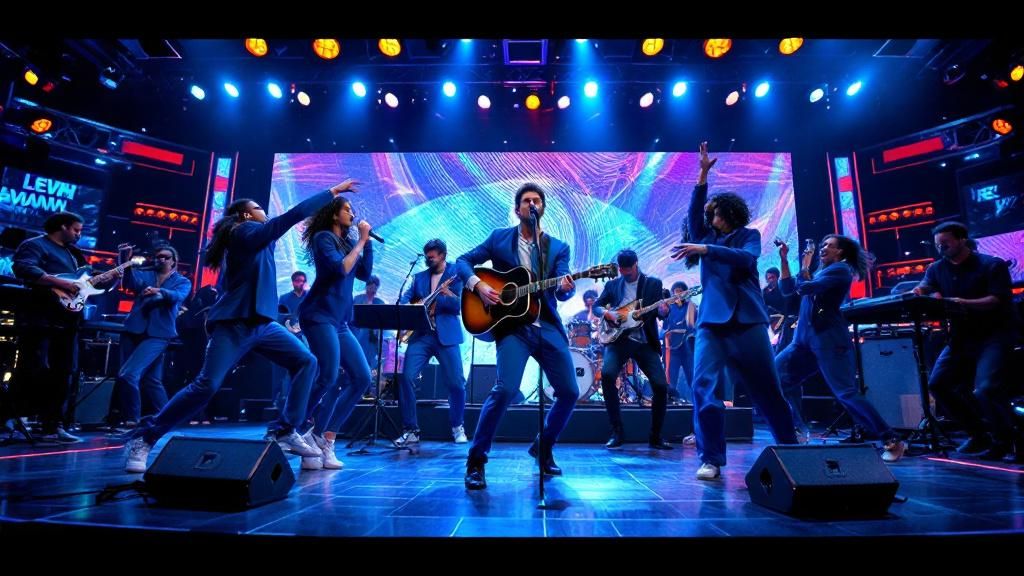
David Byrne delivered dynamic theatrical flair to The Late Show on 31 March, performing a striking performance of “When We Are Singing” alongside Stephen Colbert. The Talking Heads lead vocalist, joined by a group of blue-dressed musicians and dancers, displayed the full choreographic vision that has become his signature style. The track comes from his latest album, Who Is the Sky?, issued in September 2025. During his appearance, Byrne discussed his intentional turn towards vibrant, visually engaging presentations and explained his approach to combining solo work with classic Talking Heads hits on his current tour, featuring “Psycho Killer” and “Life During Wartime,” whilst upholding creative authenticity.
A Theatrical Come Back to Late-Night Television
Byrne’s appearance on The Late Show represented a remarkable demonstration of his developing creative outlook, one that prioritises spectacular visuals and precise choreography. The interpretation of “When We Are Singing” illustrated his inclination to tackle composition with wit and self-awareness, finding amusement in the peculiar facial expressions singers necessarily make during live singing. When examining his songwriting approach with Colbert, Byrne revealed an almost anthropological curiosity about the mechanics of singing, observing how performers’ open mouths create an ambiguous expression that could indicate either profound pleasure or basic physiological requirement. This intellectual approach to artistic performance distinguishes his work from mainstream pop music.
The aesthetic transformation evident in Byrne’s present tour showcases a conscious abandonment of his previous grey production design, a conscious choice stemming from current societal requirements. He outlined a coherent philosophy: the times call for colour, vibrancy, and visual warmth instead of austere minimalism. This change reveals Byrne’s awareness of the psychological environment of his audience and his acknowledgement that stage design expresses meaning as powerfully as lyrics or melody. By collaborating with his blue-clad ensemble, Byrne has created a integrated visual aesthetic that complements his sonic investigation whilst conveying an hopeful, progressive artistic direction.
- Byrne intentionally chose “When We Are Singing” to underscore the ridiculous nature of facial expressions
- Current tour showcases vibrant blue costumes replacing previous grey visual design
- Performance incorporates Talking Heads classics alongside solo material from Who Is the Sky?
- ICE footage woven in deliberately at conclusion of “Life During Wartime” for impact
The Conceptual Framework Behind Who Is the Sky?
David Byrne’s most recent album, Who Is the Sky?, released in September, represents a continuation of his lifelong investigation into human behaviour, perception, and artistic expression. The record serves as a creative wellspring for his present touring venture, with “When We Are Singing” demonstrating his ability to extract profound observations from daily instances. Byrne’s approach to songwriting stays distinctly intellectual, transforming ordinary observations into compelling musical narratives. The album’s thematic concerns—how we portray ourselves, what our expressions reveal or conceal—inform every aspect of his live performances, creating a unified creative vision that extends beyond traditional album promotion into something more philosophically ambitious.
The artistic fusion between the new material and Byrne’s reimagined concert aesthetic creates a unified experience for audiences. Rather than treating Who Is the Sky? as simply another body of work to be staged, Byrne weaves its conceptual framework into the visual and choreographic dimensions of his shows. This comprehensive strategy demonstrates his long-standing dedication to dissolving boundaries between sound, movement, and visual expression. By choosing particular pieces like “When We Are Singing” for elaborate theatrical treatment, Byrne demonstrates how contemporary songwriting can move beyond the recording studio and achieve full realisation as performance art on stage.
Reimagining the Concert Experience
Throughout his body of work, Byrne has repeatedly rejected the idea of static, unchanging live performances. His artistic vision prioritises ongoing development and adaptation, treating each concert run as an occasion to reimagine how audiences should engage with music in performance. The move from subdued staging to vibrant, colourful production design reflects this commitment to reinvention. Rather than relying on backward-looking sentiment or past achievements, Byrne deliberately develops innovative visual frameworks that support his ongoing artistic concerns, ensuring that his presentations remain current and deeply affecting rather than merely retrospective.
Byrne’s partnership with his group of blue-clad musicians and dancers constitutes a intentional commitment to dance narrative. By working with skilled artists who grasp both musical and movement vocabularies, he creates multifaceted shows where dance, costume, and music communicate simultaneously. This multidisciplinary approach distinguishes his shows from conventional concert experiences, framing them instead as immersive creative experiences. The combination of Talking Heads classics paired with new material demonstrates that reinterpreting doesn’t require discarding one’s history—rather, it involves placing earlier work within new artistic contexts that respect their authenticity whilst investigating fresh directions.
Harmonising Heritage and Progress
David Byrne’s way of engaging with his catalogue shows a sophisticated grasp of artistic responsibility. Rather than setting aside his Talking Heads era or becoming entirely defined by it, he has constructed a approach that enables him to honour the past whilst maintaining creative autonomy. This balance demands deliberate curatorial choices—selecting which classic tracks merit featuring in contemporary sets, and how they should be contextualised within new artistic frameworks. Byrne’s readiness to play “Psycho Killer” and “Life During Wartime” alongside solo material demonstrates that legacy need not equate to stagnation or cynical nostalgia-chasing.
The risk Byrne points out—becoming a “legacy act that performs the old hits”—represents a genuine artistic trap that many established musicians face. By deliberately reducing his dependence on earlier material and constantly reimagining sonic landscapes, he sustains creative credibility whilst acknowledging his past. This approach safeguards both his integrity and his audience’s engagement, ensuring that concerts function as vital meaningful performances rather than retrospective showcases. His resistance to committing to a full Talking Heads reunion further underscores his commitment to artistic evolution over commercial convenience.
Talking Heads Work in Modern Context
When Byrne delivers “Life During Wartime” today, the song holds distinctly modern resonance. By securing ICE footage to complement the track’s close, he transforms a 1979 post-punk piece into a statement about today’s political landscape. This editorial approach—showing the imagery merely at the track’s finish rather than across the entire performance—demonstrates sophisticated editorial judgment. The approach recognises the footage’s emotional weight whilst ensuring the performance from becoming overwhelmingly bleak or didactic, maintaining the song’s artistic vision whilst deepening its present-day importance.
This contextual approach goes further than simple visual support. Byrne’s commitment to weaving Talking Heads material into his active ensemble’s aesthetic framework establishes creative conversation across temporal boundaries. The costumed performers and vibrant staging transform how audiences experience these familiar songs, discarding nostalgic expectations and requiring genuine participation with their contemporary meanings. Instead of maintaining the songs locked in the past, this approach allows them to breathe within new artistic contexts.
- Strategic incorporation of signature songs prevents artistic stagnation and nostalgia-driven positioning
- Visual recontextualisation strengthens contemporary relevance without destroying original integrity
- Refusing reunion allows Byrne to manage the timing and manner in which Talking Heads work is presented
The Foundations of Excellence
David Byrne’s strategy for live presentation extends far beyond simply performing music—it embodies a thoughtfully developed creative vision rooted in visual story-telling and spectator psychology. During his slot on The Late Show, he expressed this viewpoint with distinctive care, describing how apparently ordinary observations about human behaviour shape his artistic choices. His interpretation of “When We Are Singing” exemplifies this philosophy: the song stemmed from Byrne’s insight that singers’ open jaws during vocal performance create an equivocal look—one that could indicate either deep ecstasy or simple physiological necessity. This sardonic observation converts into theatrical content, showing how Byrne draws from daily life for artistic substance.
This philosophical framework informs his broader approach to tour production and staging. Rather than treating concerts as fixed renditions of pre-recorded work, Byrne regards each tour as an chance for complete artistic reimagining. His determination to introduce the present tour with colour—an intentional contrast to the grey visual language of his previous staging—reveals deeper beliefs about art’s role in society. In his estimation, today’s audiences facing uncertain times demand visual vitality and chromatic abundance. This is far from being a stylistic preference; it reflects Byrne’s belief that theatrical art bears a duty to elevate and energise, to offer sensory and emotional enrichment beyond the music alone.
The Importance of Colour Today
Byrne’s explicit statement—”the times we live in, we need some color”—demonstrates how he positions artistic decisions within wider cultural landscapes. The shift from grey to vibrant blue-clad dancers and colourful set design reflects his conviction that visual aesthetics carry political and emotional weight. This choice acknowledges contemporary anxieties and uncertainties whilst providing an antidote through colour saturation. Rather than withdrawing towards austere monochrome, Byrne insists that artistic expression must fundamentally oppose despair through its chromatic vocabulary, converting the performance space into a venue of intentional, vital chromatic expression.
