
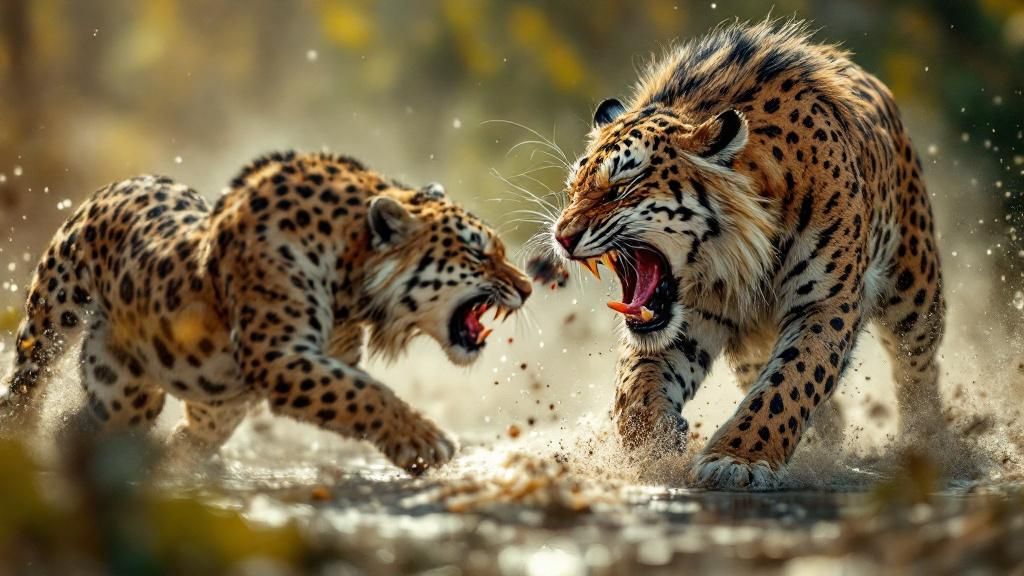
From the frozen Arctic to the heart of Europe’s cities, nature has delivered a remarkable array of moments this week, capturing the imagination of conservationists and wildlife lovers alike. A juvenile Iberian lynx in Spain has won international acclaim for its hunting prowess, whilst an surprising arrival turned up browsing toy kangaroos in a Tasmanian airport. Meanwhile, conservationists are celebrating a pair of mountain gorillas delivered in the Democratic Republic of the Congo, a positive indicator for the recovery of endangered species. These sightings, spanning continents from Canada to Cambodia, showcase both the resilience of wild animals and the pressing conservation challenges facing our planet’s most vulnerable creatures.
Predator-Prey Relationships: Nature’s Food Web in Focus
Nature’s most dramatic moments often unfold in the relationship between predator and prey, and this week has offered stunning visual proof of the brutal truth of life in the wild. Josef Stefan’s prize-winning photograph captures a juvenile Iberian lynx in Ciudad Real, Spain, performing the fundamental act of predation—tossing a small mammal into the air before completing the hunt. The image, which won the Nuveen People’s Choice honour at the Wildlife Photographer of the Year awards awards, tells us that underneath the aesthetic appeal of wildlife lies an unforgiving necessity. Every creature, regardless of age, must develop the competencies necessary to survive in an increasingly difficult environment.
Beyond the Spanish lynx, various carnivores continue their eternal hunt across the globe’s diverse ecosystems. In the cold stretches of Cambridge Bay, Nunavut, an arctic fox’s white coat offers excellent concealment against the snow, where temperatures plummet to around -29°C in March. Meanwhile, in the temperate areas of Oregon, a ladybird—one of nature’s most efficient pest controllers—searches through a roadside weed. Though diminutive in size, these beetles are able to devour numerous aphids in a single day, serving a crucial function in sustaining natural stability. These encounters underscore how predation occurs at every magnitude, from the massive lynx to the microscopic battles between insects.
- Iberian lynx showcases hunting techniques in Spanish wildlife photography
- Arctic fox depends on camouflage in harsh Arctic environments
- Ladybirds regulate pest populations through prolific aphid eating
- Wildlife Photographer of the Year showcases hunting and survival dynamics across the globe
Surprising Meetings: When Animals Move Into Our Spaces
Whilst most animal photography captures creatures in their native environments, some of nature’s most entertaining instances occur when animals venture into decidedly human-dominated areas. These surprising meetings remind us that the boundary between the wild and the developed world grows increasingly blurred, with wildlife adjusting to city and commercial spaces in remarkable fashion. From airport terminals to riverside docks, animals display impressive ingenuity in exploiting the spaces we’ve created, often with results that range from delightful to concerning for both species involved.
Such intrusions illustrate the intricate dynamic between human development and wildlife conservation. When animals wander into shops, airports, and other public areas, it frequently suggests either urgent need for food or mere inquisitiveness about novel environments. These encounters, whilst occasionally inconvenient for humans, offer important chances to observe animal behaviour and emphasise the significance of shared-space approaches. Animal management teams and local communities join forces to securely transport displaced animals, transforming potentially dangerous situations into teaching experiences.
The Peculiar Case of the Airport Possum
In a delightful incident at Hobart Airport in Tasmania, a wild brushtail possum was found browsing toy kangaroos and dingoes in an airport gift shop—seemingly conducting its own duty-free shopping expedition. The resourceful marsupial was safely apprehended and returned to its original home, unharmed by its surprising shopping excursion. The possum’s short time as an accidental shopper engaged the fascination of airport staff and passengers alike.
The store’s employees, captivated by their furry visitor, voted on what to call the intrepid marsupial, transforming a routine wildlife removal into a memorable community moment. This incident demonstrates how urban wildlife can adapt to human spaces, seeking refuge or sustenance in unexpected locations. The possum’s effective removal demonstrates the importance of swift, compassionate responses to such situations, ensuring both human safety and animal welfare.
- Brushtail possum found browsing in Tasmanian airport gift store
- Staff carefully removed and relocated possum to the wild
- Airport community chose a name for the adventurous marsupial guest
Conservation Triumphs and Emerging Discoveries
Amidst rising environmental challenges, recent ecological advances offer real cause for optimism. In the Democratic Republic of the Congo’s Virunga National Park, conservationists have celebrated the birth of mountain gorilla twins—a male-female pairing—marking the second twin birth in just two months. This significant development signals promising trends about gorilla population health and breeding achievement within the park’s conservation area. Such births are important benchmarks in population recovery initiatives, particularly given the mountain gorilla’s previously threatened status. The consecutive twin births demonstrate that intensive conservation strategies, combined with dedicated protection of critical habitats, can yield measurable results in halting population loss and establishing viable breeding communities.
At the same time, wildlife researchers have recorded troubling patterns affecting other species. The Wildlife Conservation Society has made pressing appeals for international action to protect striped hyenas, which face escalating dangers across their range. With fewer than 10,000 individuals left worldwide and populations in steady decline, the species is classified as near threatened. Conservation efforts must reconcile safeguarding of remaining populations with habitat protection and human-wildlife conflict mitigation. These parallel developments underscore the intricate terrain of modern conservation—where some species show encouraging signs of recovery whilst others demand immediate intervention to prevent further decline.
| Species | Conservation Status |
|---|---|
| Mountain Gorilla | Endangered (improving with recent twin births) |
| Striped Hyena | Near Threatened (declining globally) |
| Southern White Rhinoceros | Critically Endangered (relocation efforts ongoing) |
| Iberian Lynx | Vulnerable (recovering in Spain) |
Recently Discovered Species in Ancient Ecosystems
Wildlife surveys in Cambodia have yielded extraordinary discoveries within the country’s karst ecosystem. Researchers exploring Phnom Prampi cave in Battambang uncovered a remarkable novel pit viper species, characterised by its remarkable colouration and sophisticated hunting mechanisms. This highly venomous serpent features heat-sensing organs located behind its nostrils, enabling it to track warm-blooded prey with precision in the cave’s darkness. The discovery represents just one of many newly identified species identified within Cambodia’s distinctive karst terrain, highlighting the region’s exceptional biodiversity and evolutionary significance.
These findings underscore the importance of systematic biological surveys in remote locations. Ancient cave systems and karst formations harbour species found nowhere else on Earth, constituting evolutionary laboratories where organisms have adapted to specialised environments over millennia. The finding of novel pit viper taxa alongside other organisms illustrates that comprehensive exploration remains essential for understanding global biodiversity. Such discoveries guide conservation efforts and increase scientific comprehension of evolutionary adaptation, particularly regarding how species adapt to harsh habitats to thrive and persist.
Evolution and Resilience: The Engineering Wonders of Nature
The natural environment exhibits extraordinary sophistication in how species have evolved to thrive within their particular habitats. From the arctic fox’s pure white fur offering concealment against the frozen Arctic conditions to the pit viper’s heat-sensing capabilities in caves of Cambodia, natural selection has produced extraordinary solutions to survival challenges. These adaptations represent vast spans of development, enabling creatures to exploit ecological niches that would otherwise stay barren. The intricacy of such natural engineering—whether sensory systems, defensive colouring, or behavioural strategies—reveals nature’s ability to innovate and refinement in response to pressures of the environment and resource availability.
Smaller creatures prove equally resourceful in their approach to survival. Ladybirds, despite their diminutive size, serve as nature’s pest controllers, consuming dozens of aphids daily and preserving ecological equilibrium within farming and natural environments. Meanwhile, mallard hens show adaptive behaviour by selecting unconventional nesting sites, such as anchored rowing boats on the Thames, when natural habitats become inadequate. These examples highlight how species across all scales—from minute evolutionary adjustments to flexible responses—continually adjust to shifting environments, securing their survival in increasingly variable and human-dominated landscapes.
- Arctic foxes blend seamlessly into snow at conditions dropping to minus twenty-nine degrees Celsius.
- Pit vipers detect warm-blooded prey using thermal detection organs located near their nostrils.
- Ladybirds consume dozens of aphids each day, providing natural pest control for ecosystems.
- Mallard hens adjust breeding habits by utilising man-made structures like rowing boats.
- Iberian lynx develop hunting skills through interactive hunting practice before consumption.
Climate Challenges and Resilience
Climate extremes present formidable challenges to wildlife populations globally. In polar areas like Cambridge Bay, Nunavut, where temperatures plummet to −29°C during March, species survival hinges on physiological and behavioural adaptations refined over generations. The arctic fox’s thick coat and compact body structure reduce heat loss, whilst adaptive behaviours such as denning and cooperative hunting boost survival odds. These adaptations become ever more essential as global warming alters seasonal patterns, ice formation timelines, and food supply, driving species to respond rapidly to unprecedented environmental shifts.
Conservation efforts increasingly recognise that protecting species requires safeguarding the ecosystems and climatic conditions upon which they depend. The relocation of southern white rhinoceroses to suitable habitats, such as Kidepo national park in Uganda, represents proactive intervention acknowledging habitat degradation and climate vulnerability. Similarly, the recent twin births of mountain gorillas in Virunga national park signal that species can recover when provided appropriate protection and stable environments. These conservation successes, though modest against global biodiversity challenges, demonstrate that strategic intervention combined with|strategic intervention paired with habitat preservation can help species navigate an increasingly precarious environmental future.
Times of Tranquility: Wildlife at Rest and Play
Amidst the dramatic struggles for survival that define the natural world, peaceful interludes reveal wildlife engaging in everyday behaviours that underscore their exceptional ability to adapt. A mallard hen has claimed an unlikely sanctuary aboard a wooden rowing punt moored on the Thames at Henley, Oxfordshire, fashioning a sheltered nest beneath the gunwale where she now sits calmly on her eggs. This opportunistic nesting behaviour demonstrates how birds utilise human infrastructure to their advantage, transforming leisure vessels into safe havens during vulnerable breeding seasons. Similarly, a young hare has sought refuge in a field on Frankfurt’s outskirts, relying on camouflage and stillness to evade detection whilst remaining alert to potential threats in its grassland habitat.
Play and learning form key aspects of creature growth, notably within carnivorous animals perfecting hunting techniques. An Iberian lynx featured in Josef Stefan’s prize-winning photograph illustrates this principle vividly, gently throwing a rodent into the air before catching and devouring it in Ciudad Real, Spain. Such behaviour, captured by the Wildlife Photographer of the Year competition, reveals how juvenile hunters perfect techniques crucial for surviving alone. Even moments of apparent leisure—whether a brushtail possum’s curious exploration of an airport toy shop in Tasmania or a ladybird feeding on wayside plants—reveal the constant, purposeful engagement of creatures traversing their habitats with exactness and natural ability.
- Mallard hens employ artificial nesting sites for nesting when natural sites are insufficient or hard to reach.
- Young predators build hunting abilities through playful practice with captured prey items.
- Wildlife shows remarkable behavioural flexibility thriving in urban and modified environments.
- Camouflage and stillness are essential survival techniques across various species and different habitats.
